Friday, June 3, 2016
Muriel's Treasure, Vol. 2

Thursday, June 2, 2016
The Avalanches - "Frankie Sinatra"
The Great calypsonian Wilmoth Houdini takes uncredited vocal turns in this video by the Avalanches for their single, "Frankie Sinatra." The sampled song is "Bobby Sox Idol," which Houdini recorded in the early 1940s to celebrate the young crooner who made female hearts flutter on concert stages, over radio airwaves, and on 78 rpm platters.
HT: Mike Noble
Wednesday, February 3, 2016
Muriel's Treasure, Vol. 1
02 The Lion - Trinidad, Land Of Calypso
03 Mighty Sparrow - The Slave
04 Duke & the Jamaica 5 - Bloodshot Eyes
05 Wilmoth Houdini - Bobby Sox Idol
06 George Symonette - Coconut Water, Rum And Gin
07 McClevertys - Don't Blame It On Elvis
08 Duke of Iron - Fifty Cents
09 Mighty Zebra - Man Smart, Woman Smarter
10 Duke & the Jamaica 5 - Hungry Woman
11 Lili Verona - Massa Johnny
12 Duke of Iron - The Music Lesson
13 Duke Errol & the Lords - Mama Look'a Boo Boo
14 Lord Brynner - Hang Them High
15 Lord Kitchener - Smoke A Cigarette
16 Count Lasher & Williams - Mufradite
17 Talbot Bros - Too Much Rock & Roll
18 Duke Errol & the Lords - Shame And Scandal
19 Mighty Dougla - Split Me In Two
20 Mighty Zebra - We Like Ike
21 Duke Errol - Back To Back and Belly To Belly
22 Lord Christo - Trip To Mars
23 Two Gun Smokey - Vacation
24 Nap Hepburn - The River
25 Mike Alexander & the Pott Steelers - You Are My Sunshine
Tuesday, May 11, 2010
Calypsos for Adam and Eve
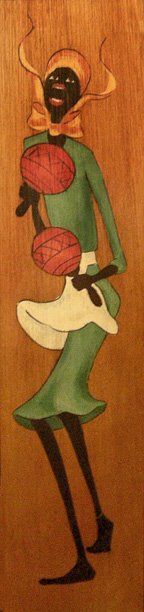
This vivacious tropical cover for the Monogram label (disc: Kalypso Records Ltd., Jamaica) appears to be the handiwork of the same uncredited artist who illustrated Ritmo's Calypsos from Jamaica. Wednesday, November 25, 2009
The Day Van Dyke Parks Went Calypso
Crawdaddy magazine (Nov 19): "Parks is generally a well-mannered and affable Southern-born gent with a mildly mischievous streak. A one-time child prodigy on clarinet, he’s often mentioned in tandem with his Southern California work with Beach Boy Brian Wilson, who was reportedly too tripped-out to continue their Smile-era collaborations. A formidable freethinker and raconteur of psychedelic dimensions himself, you can hear the Parks imprint, curly-cuing through 'Heroes and Villains' and 'Sail On, Sailor.' ... Rarely at a loss for bookings as a composer, arranger, musician, and producer (Parks would go on to work with artists from Harry Nilsson and Ringo Starr to Joanna Newsom and Rufus Wainwright), ... he juggled sessions by psychedelic bands as well as singer-songwriters Randy Newman and Phil Ochs. It was following the critical success of his first solo work, Song Cycle, in 1968 and the oil spill in ’69, that Parks began in earnest his pursuit of the music of the West Indies—specifically calypso and ... steel pan."Saturday, February 2, 2008
Nobody but she husband

"Murder is nothing to brag about"—unless it sells a half-million records. TIME magazine fĂȘtes calypsonian Wilmoth Houdini, August 26, 1946.
HT: Doug Schulkind
Sunday, July 15, 2007
David Stone Martin does Calypso
Disc Records 78 rpm CALYPSO album with cover illustration by the legendary David Stone Martin (1913-1993), whose work adorns hundreds of 1940s and 1950s jazz, blues, folk, and ethnic records.In the early 1940s, the Chicago-born and -bred Martin befriended artist Ben Shahn, whose work proved inspirational. Martin got started in album cover design in 1944 when his friend, pianist Mary Lou Williams, persuaded her label to hire Martin to illustrate her next release. The company honcho, Moses Asch, was so impressed by Martin's virtuosity that he hired him as art director.

In the 1950s, Martin's moody figure studies for Norgran, Clef, Verve, and Mercury practically defined the illustrated jazz LP cover (in a manner far different than, say, Jim Flora). Eric Kohler, who reprinted over a dozen classic Martin LPs in his book In The Groove: Vintage Record Graphics 1940-1960, observed: "Many of Martin's covers did not have an actual image of the recording artist, but rather an abstract image that might recall the feeling of the music."
A book of his work, Jazz Graphics: David Stone Martin, was published in Japan in 1991. It is, sadly, out of print and hard to find. Martin's vital, cosmopolitan line art deserves renewed circulation.
The calypso album above contains three sides by Lord Invader ("Tied-Tongue Baby," Yankee Dollar in Trinidad," and "New York Subway") and three by Lord Beginner ("Shake Around," "Nora, the War is Over," and "Always Marry a Pretty Woman").
Thursday, May 31, 2007
Sir Galba
London-based Kate Blenman is great-grand niece of Sir Galba, a Trinidad calypsonian who reigned briefly in the late 1940s and early 1950s, but led a troubled life. Kate discovered one of his songs on a Muriel's Treasure playlist, and wrote that despite years of searching, she had never been able to find any of Galba's music. She explained about her great-grand uncle:
Most of the information I have was obtained from Ray Funk, a kaiso researcher. Galba's real name was George Brindsley McSween, and he made his recording debut in 1946 with "Hooligan Hide Yourself" and "Put the Knife on the Shelf." In 1949 he recorded "Calypsonian from Toco" and "Residents of Nowhere Square." He was crowned Calypso King of 1952 at the Young Brigade with "Man in the Garden Hiding" out of the Victory tent. That same year he stabbed someone in a nightclub. He sang "I Don't Want Any Women Police in Trinidad" and won second place in an intercolonial calypso contest for Princess Margaret in 1955, singing "The Queen at Montego Bay." He also recorded three singles for the Sagomes label. He died September 18, 1957, at the age of 38, by committing suicide after stabbing his girlfriend.
"Too Many Fires" is the only recording I've heard by Galba. An mp3 transfer from an original 78 (Sagomes 138-27) was provided by friend and Optigan savant Pea Hicks, who does all manner of audio restoration. It can be heard here (about 20 seconds in).
Update (5 May 09): Hear Sir Galba's "Bajan Diplomat," a Vitadisc 45 courtesy listener John Hill (with thanks to Don Brockway for the mp3 conversion).
Friday, May 25, 2007
It's The Rhythm We Want
It's pricey—anywhere from $196.06 to $305.99. Lifting it could dislocate your vertebrae. In today's media-saturated, sensory overloaded world, no one will have time to absorb it all.But you must buy it. Now.
West Indian Rhythm, released in 2006 by the obsessives at Bear Family Records, is one of the best collections of classic calypso ever commercially released. Hyperbole? Forget it — there's nothing comparatively close. You want deep cuts? Start here.
The historic collection contains all but one of the 268 performances recorded by New York engineers of Decca Records on field trips to Trinidad in 1938, '39, and '40. (Yes, one track is AWOL. Don't think the producers of this album didn't search exhaustively for it.)
Besides ten CDs of music — 267 rare recordings, impeccably remastered — West Indian Rhythm comes packaged with a 316-page hardcover book that contains so much essential and authoritative information, is so beautifully designed and so dedicatedly researched, that it's a bargain at any price. Colorfully written essays chronicle the history of the genre and the artists who developed it. There's a glossary of calypso terms; lyrics transcribed for every track; photos; hundreds of illustrations; news clippings; bios of the singers and entrepreneurs; discographies. The CDs include a dozen or so previously unreleased — that is, censored — songs. The only thing they didn't include is a bottle of rum.All performances were recorded in one take. Decca didn't return in 1941 or thereafter, so you've got the history of pre-World War II Trinidad calypso preserved in amber. Legends like Atilla the Hun, Cyril Monrose, Lord Invader, Tiger, Lion, Growler, and King Radio. Forgotten footnotes like Codallo's Top Hatters, Joe Coggins, and Lord Ziegfield. A dozen songs about Hitler, and countless syncopated chronicles of unfaithful wives, drunken louts, lecherous old men, and municipal scandals.
If you needed any further convincing about the integrity of this package, the name Dick Spottswood appears prominently in the credits as Reissue Co-Producer. 'Nuff said."These compelling performances personify calypso at its best," writes Spottswood. "Mostly sung in English, they represent a sophisticated world-view unique to the small population of a remote Caribbean island. Popular music in England and North America at the time was largely escapist, designed for social dancing and romantic fantasy. Calypso ignored those tendencies, replacing romanticism with scepticism, and mindlessness with content. The calypso chantwell [singing storyteller] observed events at home and abroad with informed incredulity, readily pronouncing humorous judgments that nonetheless ranged from troubled acceptance to outright contempt."
Be good to yourself. Splurge. It will take you a year to get through this box and you'll continue listening for the rest of your life.
Center photo L to R: King Radio, Beginner, Executor, Tiger, 1939
Bottom photo L to R: Lord Invader, the Growler, Atilla the Hun, Lion, February 1943
Tuesday, May 22, 2007
Wilmoth Houdini on 365 Days Project
Two Wilmoth Houdini mp3s are available for free download from The 365 Days Project, hosted by WFMU. The tracks, "He Dead, He Gone Already" and "Moan, People, Moan," were posted by Bob Purse, who adds a colorful encomium to the great Houdini.Aside from having a really cool name ..., he had a vocal style which gives me chills, featuring a wicked vibrato, and an intensity on held notes which expresses as much emotion as just about any singer I can name.
These recordings, which are not available on commercial CD, were transferred from the 1958 vinyl LP Calypso Capers. They were likely recorded in New York in the late 1930s or early 1940s.
Saturday, May 19, 2007
Let's Go Calypso (Somerset)
Features King Scratch and the Bay Street Boys, ca. late 1950s. "These two acts," the brief liner notes attest, "have long been favorites in the islands and many a tourist has felt the gay and carefree spell they cast with the charm of their readings and infectious Calypso rhythms. This is as much a part of the islands as the palm trees or lovely beaches." Despite a preponderance of cruiseship standards (e.g., "Marianne," "Sly Mongoose," "Jamaica Farewell," "Donkey Wants Water"), the performances are refreshingly "native" and highlighted by raucous percussion. Meaning, these recordings were not prettied up for export. Is good.Fabulous cover illustration, unsigned, uncredited.
Monday, May 14, 2007
Calypso Mania
Cover illustration by Demilio from the Richmond Records LP Calypso Mania by Edmundo Ros, as discovered by Ernie, who collects the artist's work.
Wednesday, May 9, 2007
Calypsos From Jamaica (Times Store)
Which is to say, Mento, an indigenous Jamaican style marketed abroad as calypso. The forms share many characteristics, both being African/European fusions filtered through Caribbean culture, and their audiences overlap. Like one, you'll probably like the other—unless you're some kind of weird contrarian.
Tuesday, May 1, 2007
The Enchanted Steel Band (Cook)
I had to "ream" this LP, because the center spindle hole was off-center, causing wobbly playback. Reaming is a highly technical process involving one blade of a double-lever scissors, positioned perpendicular to its opposite, and a rum-based cocktail, positioned less than arm's length from the work space. You carefully maneuver the blade in a back and forth carving motion to enlarge the hole and thus allow visual centering on the turntable. Each pass with the scissor is customarily followed by a sip of the cocktail.Unfortunately, due to frequent applications of the liquid, the scissors slipped and I accidentally gouged an irrigation ditch through side A, rendering it unplayable. A priceless Cook LP, ruined. The cover survives.
Sunday, April 29, 2007
Calypsos From Jamaica (Ritmo/Monogram)
A fine Mento collection featuring Hubert Porter, Lord Lebby, the Denzil Laing Trio, Harold Richardson, Lord Flea, and The Wigglers.Tuesday, April 10, 2007
Is it her treasure?
Muriel Gaines was a dancer in Harlem's Cotton Club, and started singing calypso in the 1940s at the Village Vanguard and Le Ruban Bleu. She later toured Europe, where she was dubbed the "Queen of Calypso." She released two calypso records in 1945 on the National label, accompanied by Sam Manning's Serenaders: "Ugly Woman" c/w "You Got to Have Power," and "What You Gonna Do" c/w "Too Sweet, Too Sweet."Above: Muriel on the cover of Jet (May 29, 1952)